Albert Einstein is quoted as having said that “Education is not the learning of facts, but the training of the mind to think.” This approach to creating curriculum resonates especially well when designing experiences for toddlers, who have quite a few years left before it comes time for them to sit at desks and start memorizing for tests. These are the years where every experience and observation that children absorb are teaching them how to think; they make connections, deepen their understanding of the world around them, and follow their natural curiosity into various roadblocks or dead ends that then teach them how to adapt and problem solve.
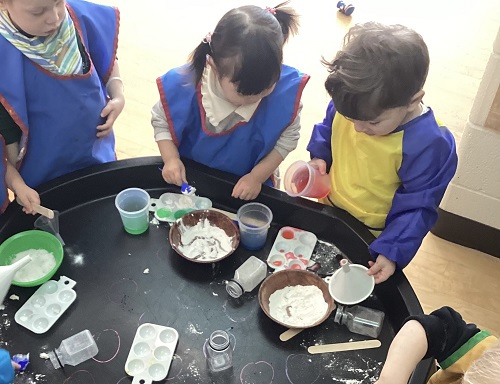
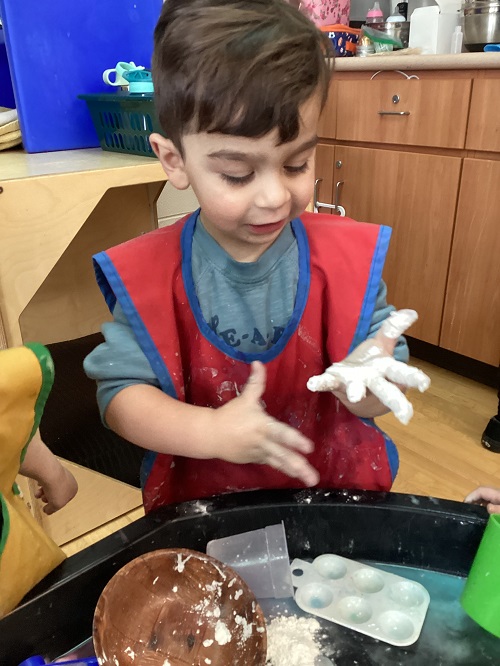
In this way, a science experiment we may overlook as simple and straightforward like mixing baking soda and vinegar does far more for little minds than just showing them that baking soda and vinegar makes bubbles. On a chilly February morning, the toddlers were given the opportunity to explore a provocation made up of various ingredients and tools. The display included the aforementioned baking soda and vinegar, along with corn starch, flour, and water with some drops of food colouring added to make the different cups and bottles more visually interesting. The ingredients were presented alongside clear bottles, paint palettes, eyedroppers, cups, and spoons. The children were invited over to the display with smocks to protect their clothes from the inevitable mess and encouraged to begin making their discoveries.
The more senses children are able to engage at once, the deeper they can connect with the experience and the learning that happens throughout. They smelled (and in some cases, tasted) the sour vinegar; listened to the mixtures bubble and fizz; touched the textures of the three different powders to discover how they looked the same, but felt quite different; and saw how the various combinations interacted and changed. These are foundational elements of scientific and broader learning — using the tools we have available to identify components and how they interact with each other.
Another aspect of science with toddlers that can’t be understated is how it encourages the development of communicative skills. With every sense comes a long list of descriptive vocabulary that can be used to put how something looks, sounds, smells, tastes or feels. At each stage of the activity, the children were prompted with open-ended questions leading them to focus on their senses. “How does the corn starch feel? How about the baking soda? What can you hear when you add vinegar? What do you notice about how it feels after it has been mixed together?” After giving the children time to ponder those questions, educators also offered a few words that may have matched, such as “soft,” “dry,” “fizzy,” and “sticky.” This promoted vocabulary building and essential tools for self-expression as they connected words to sensorial input.
When we as adults think back to what we learned in school, it’s easy to think that science is too tough for toddlers. However, the essence of science is curiosity, and toddlers have an abundance of it! There is so much to gain by offering them any means of hands-on exploration with even the most ordinary things.