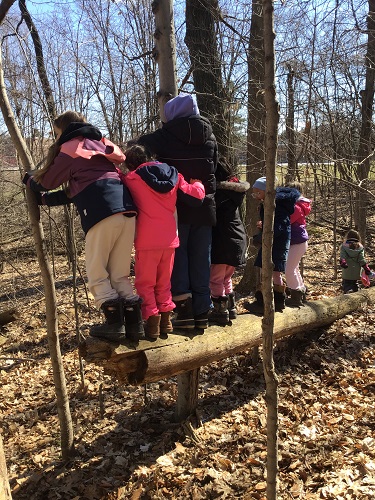
 As the children’s curiosity and connection to the natural world continued to grow, they were observed collaborating in meaningful and innovative ways throughout their play and exploration. While outside in the forest, the children worked together to create their own seesaw using natural materials. Their teamwork and problem-solving soon expanded as they recruited additional peers to help them attempt to break a large log. The children hypothesized that if everyone stood on one side of the log and jumped together, the force may be strong enough to snap it. Although their first attempt was unsuccessful, the children demonstrated perseverance and critical thinking as they adapted their plan and searched for a smaller log. This time, their efforts were successful, and the excitement and cheers echoed throughout the forest.
Building on this growing interest in experimentation and discovery, the children later collected dirt outdoors and brought it inside to create their own mud paint. By adding water and food colouring, the children explored how natural materials could be transformed into art materials. During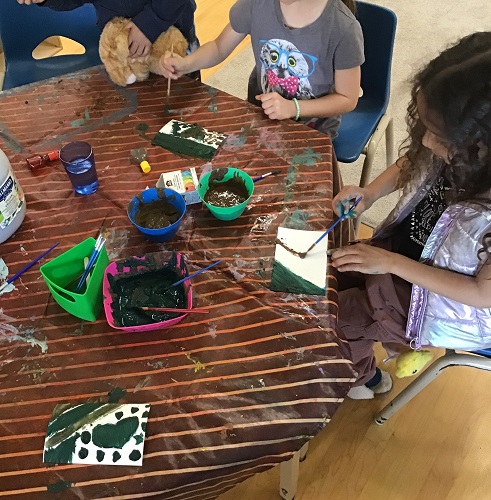 the process, the children noticed that the blue food colouring appeared much more vibrant in the mud mixture, while the yellow and red were difficult to see. Curious about these observations, the children wondered if paint would produce different results. The following day, they independently gathered painting materials, including blue, red, and yellow paint, brushes, water, and mud, and continued their investigation. Through trial and error, the children discovered that the blue food colouring still showed up clearly, while the red paint blended better with the mud than the food colouring had. The yellow continued to be difficult to see. The children thoughtfully reflected on their findings and suggested that using lighter sand or adjusting the paint-to-sand ratio might create better results. This ongoing inquiry encouraged the children to think like scientists as they tested theories, made predictions, observed outcomes, and reflected on possible changes for future experiments.
To further extend the children’s investigations, scales were introduced outdoors to encourage exploration of weight and measurement using natural materials. The children collected large rocks and engaged in discussions about which rocks they believed would be heavier before placing them on the scale to test their predictions. Alongside this exploration, the children also created their own mud kitchen using pots, scoops, plates, and cups. Together, they prepared and presented imaginative meals while engaging in collaborative role play. Conversations naturally emerged surrounding outdoor cooking, camping experiences, and how people prepare food while living in nature. The children discussed foods that can be cooked over a fire and explored ideas about survival in the wilderness without access to appliances such as fridges or stoves.
The children’s growing appreciation for nature also inspired creative expression. While outdoors, the children eagerly collected leaves, sticks, stones, grass, and dirt. Educators invited the children to bring these materials inside to create nature-inspired name art. Using cardboard and glue guns, the children carefully arranged and attached natural materials to form their names. This experience encouraged creativity, fine motor development, and a sense of identity and belonging. To further extend this interest, educators introduced small jars, gems, and greenery for the children to create their own terrariums. When the children realized the jars did not have lids, they independently problem-solved by cutting out paper circles, decorating them, and placing them on top as lids.
The children also demonstrated confidence and resourcefulness during outdoor baseball play. Using large sticks found in the forest as baseball bats, the children selected materials that felt comfortable and meaningful to them. Rocks were initially used as bases; however, after group discussions surrounding safety and care for one another, the children agreed that the rocks could create a risk of injury. Together, the group problem-solved and gathered proper bases and a plastic bat from storage. Although the children enjoyed using the provided materials, some continued to express that the log bats felt more effective for their play, demonstrating their ability to compare materials and reflect on their preferences.
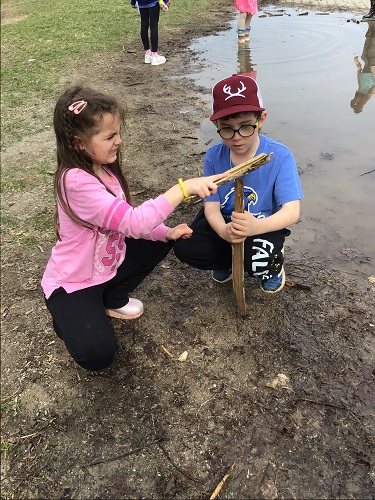 Following a rainy day, the children became deeply interested in worms and eagerly searched outdoors to find them. During their conversations, the children shared a variety of facts they already knew about worms, including that worms breathe through their skin, have five hearts, use small stones to digest food, and produce fertilizer through their castings. Inside the classroom, the children collaborated to create worm habitats using soil, rocks, dry leaves, grass, and shredded paper. When the children noticed that the worms were no longer visible the following sunny day, they began wondering how they might “lure” worms out of the ground. One child suggested conducting research, leading the group to discover the practice of “worm grunting,” where vibrations in the soil encourage worms to rise to the surface. The children eagerly tested this method outdoors using sticks to create vibrations in the ground and were thrilled when it successfully attracted worms. The children carefully collected the worms and placed them into the habitats they had created.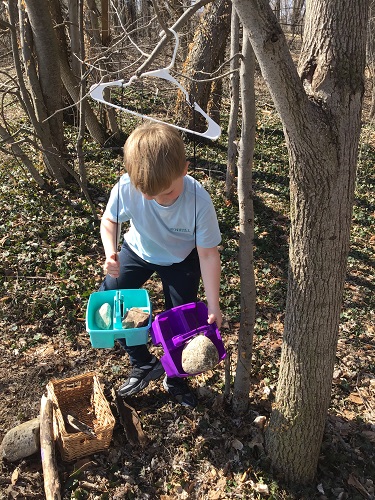
As Earth Day approached, the children expressed an interest in making seed paper. Together, the group gathered seeds, shredded paper, and soaked the paper overnight in water. The following day, the children took turns blending the soaked paper into pulp. Throughout the process, the children explored sensory experiences, with some children expressing discomfort with the texture and independently requesting gloves to support their participation. While shaping the seed paper, older children naturally stepped into leadership roles, supporting younger peers who were finding the process challenging. They assisted with shaping the paper and adding seeds at the appropriate time, demonstrating empathy, patience, and collaborative learning. Once the seed paper dried, the children proudly brought their creations home to plant in their gardens.
As a meaningful continuation of this inquiry into nature and experimentation, the children later collected dandelions outdoors. One child excitedly asked if they could conduct an experiment with the dandelions and confidently took on the role of educator while peers gathered around to observe. Carefully slicing the dandelion stem lengthwise, the child asked the group to predict what might happen when the stem was placed into cold water. The children shared a variety of thoughtful predictions, including that the stem might float or sink. As the stem curled in the water, the children reacted with excitement and wonder, eagerly expressing their amazement. The child then invited peers to participate in the experiment independently and thoughtfully created a sign-up sheet by writing each child’s name to ensure everyone had an opportunity to try.
Throughout these experiences, the children demonstrated many connections to the foundations of How Does Learning Happen?. Their collaborative investigations and shared problem-solving experiences reflected a strong sense of Belonging, as children worked together, supported one another, and built relationships through shared discoveries. The children’s confidence in asking questions, testing theories, and expressing ideas demonstrated a deep sense of Engagement, as they explored the world around them through inquiry, experimentation, creativity, and hands-on learning. Their growing independence, willingness to take risks, and ability to advocate for their needs and ideas highlighted their developing sense of Well-Being. Finally, the children’s conversations, predictions, storytelling, research, and leadership opportunities reflected rich experiences in Expression, as they communicated their thinking in a variety of meaningful ways.
Possible Next Steps:
- Continue exploring scientific inquiry through experiments using additional natural materials, colours, textures, and mixtures.
- Extend the children’s interest in worms and habitats by creating a larger outdoor composting or garden project.
- Introduce books and documentation about survival skills, camping, and outdoor living to deepen conversations about nature and sustainability.
- Explore measurement and comparison further using additional tools such as measuring tapes, magnifying glasses, or balance scales.
- Encourage the children to document their predictions, theories, and discoveries through drawings, photos, and shared storytelling.
- Continue supporting leadership opportunities where children can take on the role of “teacher” and guide peers through experiments or projects.