
 During our learning time, Lucas M and Felix joined us for a rabbit tracing activity using chalk. As they carefully traced the rabbit shapes, the educators observed Lucas M showing a great amount of focus and concentration. The other children were also engaged and interested in the activity. Watching them inspired me to think of more ways to support and extend their concentration skills through fun and hands-on experiences.
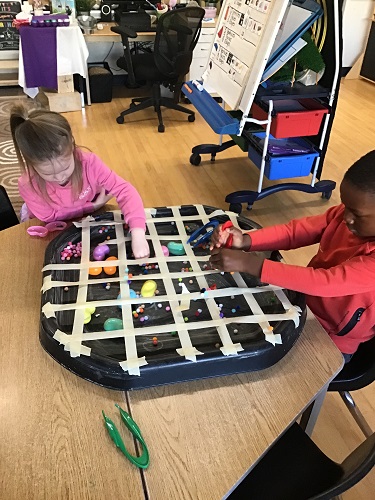
The educators introduced a new activity using pom-poms in the tuff tray. The educators covered the tray with tape and gave the children tweezers to pick up the pom-poms and place them into matching eggs. The educators added a timer to make it more exciting and challenging. O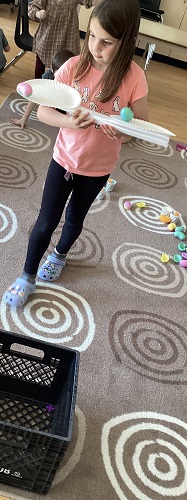 nce again, the educators noticed strong focus and concentration from the children. Aleah and Laura were excitedly talking about who collected the most pom-poms in one minute, while also matching the colors correctly with the eggs.
To further extend the learning, the educators noticed that the children really enjoyed picking and transferring objects. The educators then added thread worms into the tuff tray filled with sand, along with some jars.
The children used the tweezers to search for and collect the worms, placing them into the jars. the educators also mixed insects into the tray, and some of our friends enjoyed finding and collecting those too. The educators set the timer again for five minutes, and everyone was excited and fully engaged throughout the activity.
Wanting to continue building on their interest, the educators introduced a creative activity where we made worms using tissue paper, glue, colors, pencils, and water. Lucas M and Zyaire were very excited when the educators demonstrated how to roll the tissue paper around the pencil and add drops of water to make it look like a real worm.
Soon, all the children joined in and eagerly participated. This activity once again encouraged focus, patience, and fine motor development.
Later, the educators created a balancing activity using plates, pipes, and balls. the educators marked two points, A and B, and challenged the children to carry two balls at a time from one point to the other point and place them into a box. This activity encouraged balance, coordination, and concentration. Chloe H proudly carried the maximum number of balls and happily told everyone, "I am so fast!" with a big smile on her face.
These experiences showed how engaged children become when activities are meaningful, hands-on, and connected to their interests. Through tracing, picking, sorting, balancing, and creating, the children demonstrated increased focus, concentration, patience, and problem-solving skills. The use of timers added motivation and excitement while also encouraging perseverance.
The activities supported many areas of development. The tracing and picking activities strengthened fine motor skills and hand-eye coordination, which are important for future writing and self-help skills. Sorting pom-poms by colour supported cognitive development and early math skills such as matching and categorizing. The sensory activities with sand, worms, and insects encouraged curiosity, exploration, and sensory processing.
The balancing game 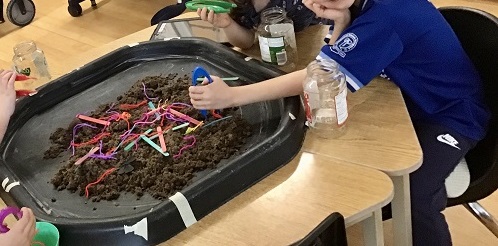 supported gross motor development, body control, balance, and coordination. The creative worm-making activity encouraged imagination, creativity, and patience while strengthening finger muscles. Socially and emotionally, the children learned to communicate, cooperate, share ideas, celebrate each other's success, and build confidence in their abilities.
These experiences highlighted the importance of following children's interests because it helps children stay engaged, motivated, and excited to learn. When children are actively involved in play-based learning, they build important developmental skills in a natural and meaningful way.
- Moving forward, the educators would like to continue providing activities that strengthen concentration, fine motor skills, gross motor skills, creativity, and teamwork. the educators wonder:
- How can we further challenge the children's focus through more sensory and movement-based activities?
- Will the children enjoy create more items using recycled and natural materials?
- How can we encourage children to create their own games?
- What other activities can support both concentration and problem-solving skills together?
Next, the educators plan to introduce more activities involving transferring, balancing, sorting, sensory play, and creative construction to continue extending their learning and development.