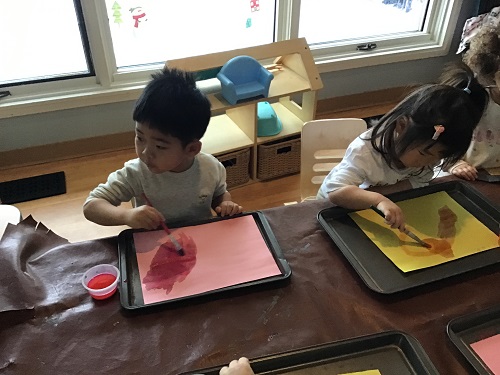
These last few weeks we engaged in many fun and exciting science experiments with the children! First, we explored what happens when baking soda and vinegar are mixed together. To begin, we prepared baking soda mixed with a little water and added pink and orange food colouring. The children were provided with paper, cups of vinegar, and droppers to squeeze the vinegar onto their paintings.
The children were able to make their own choices throughout the activity, including selecting the colour they wanted to paint with and the colour of paper they preferred. Some children chose to paint only certain areas of their paper, while others decided to completely cover their page. This allowed for creativity, independence, and self-expression.
When it was time to add the vinegar, the children were amazed by the reaction. Many showed surprised expressions and excitedly described what they observed, with some children saying it was “fizzy!” This moment sparked curiosity and encouraged scientific thinking as the children observed cause and effect in real time.
Throughout the activity, the children strengthened their fine motor skills by using droppers, squeezing vinegar, and controlling their painting movements.
As an extension of this experience, Isabel wondered what other experiments we could try using baking soda or explore other simple science activities together. These experiences help build curiosity and a love for learning through play.
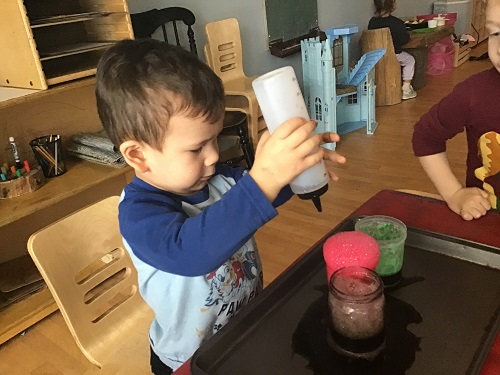
The children had so much fun exploring our vinegar and baking soda experiment that Isabel was excited to introduce a new version of it! Building on their curiosity, we set up three clear containers, each with baking soda inside. Together, the children added food colouring—pink in one container, green in another, and a mix of pink and green in the third. Through this process, the children discovered that mixing pink and green created a dark brown/black colour, sparking excitement and conversation about colour mixing. Once the baking soda and colours were mixed, we were ready for the next step. Using a squirt bottle filled with vinegar, the children took turns choosing a container and squeezing the vinegar inside. Almost instantly, the children noticed bubbling and fizzing reactions. As more vinegar was added, the bubbles grew higher and higher until they erupted like a volcano! There were many smiles, laughs, and expressions of wonder as the children observed the reaction. Through this hands-on science experience, the children explored cause and effect by observing how vinegar and baking soda interact, they practiced colour mixing and prediction. There was also a lot of turn-taking, sharing, and patience which was wonderful to see.
Next up we decided to take what we learned outdoors to explore it in a new and exciting environment. With a fresh layer of snow covering the ground, we decided to recreate a volcano using the snow as our landscape. Before beginning, we reflected on our previous discussions about volcanoes and chemical reactions. I wondered if the children would remember the experiment and what might happen this time. As we set up, many children eagerly shared that they wanted a turn, showing clear excitement and recall of the experience. This enthusiasm suggested that the learning from our earlier experiment had stayed with them. Each child had the opportunity to participate by carefully pouring the vinegar and pressing the bottle tightly, intentionally trying to create a strong “eruption.” The children watched closely as the reaction occurred, observing how the purple colour flowed beautifully against the crisp white snow. By extending a familiar experiment into a new setting, the children were able to deepen their understanding, make connections to past learning, and experience the joy of discovery in a meaningful and engaging way.