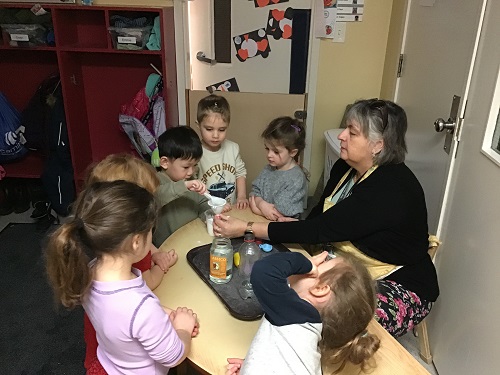
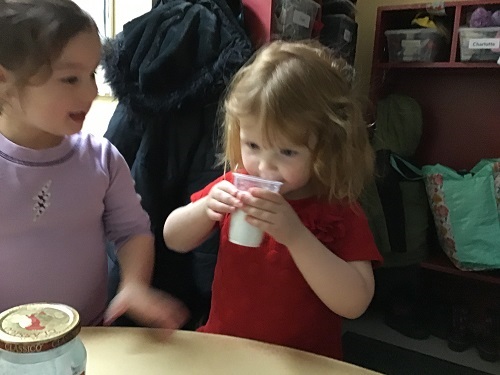
The children in preschool 2 had the opportunity to explore science during a hands-on experience. Some of the older children have explored and used the two ingredients offered before, but for others it will be their first time. Science is one of the most important activities for children as it is a way to explore the world around them through conversations, and observations with hands on testing. As the children gathered around the table the first thing they noticed was the balloons, which created an excited atmosphere. To their disappointment, I explained the balloons were for something cool and how I was not going to blow them up. Fox said “my mommy can blow up balloons for us at my home.” I explained to them that there is another way we can blow up the balloons without putting them in our mouth to do so. The children explored the two main ingredients on the table. When asked what the dry ingredient was with just a visual recognition, Lana said “sugar,” Penelope said “sand,” and Rose said “flour.” The wet ingredient Fox said was “water”, Hannah said honey, Sadie said maybe honey water and Ahrloe said “cleaning.” It was not until the children had the opportunity to smell both ingredients, when they were able to identify the liquid as being vinegar. The baking soda they insisted was flour, until they touched it. Here, the consistency was different with baking soda being firmer. The object of the activity was in two steps with the first step being to fill the pop bottle quarter full with vinegar. The second step had the children using a funnel. They had to add baking soda into the funnel that would eventually enter the balloon. Mary then placed the lip of the balloon to the top of the bottle hoping nothing would enter inside with the vinegar. Once this part was done, Theo lifted the balloon up causing the soda to fall into the vinegar liquid. The mixture of these two ingredients bubbled inside where Birdie said “look bubbles just like with Nidya’s game.” Fox was so excited he jumped up and down saying “the balloon is growing big, is it magic Mary?.” Theo backed up away from the growing balloon “just in case it popped,” he said. After tying off the balloon for the children to hold and explore, Mary explained to them that the vinegar and baking soda give off an acid based chemical reaction called gas or carbon dioxide. Hannah laughed and said people get gas too. Mary went on to explain that this gas is created by mixing together a powder or base with a liquid. Sharing that the fizzing reaction occurs and creates bubbles because the gas inside the bottle has no where to go therefore it moves into the balloon which then grows bigger. At the end of the experiment we had four different balloon sizes which we predicted it could be from how much gas was made inside the bottle.